
The challenge in training is to figure out what is the best time to go out for at your race. You don't want to take it out too slow and underestimate your abilities, but even worse, you don't want to finish in a death march to the finish line. Finding balance is always the key. The most common workout discussed is Yasso 800s. For those who aren't familiar with Yassos, here's the theory:
10 by 800 with equal rest between intervals. Run the splits at your marathon goal time for instance 3:05 marathon would be 3:05 or 6:10 pace. Some people have success with this workout, however, most do not. The reasoning for this is the yasso workout is not a marathon specific workout. The intervals will commonly be run fairly close to your 5K/10K pace, which may or may not have much to do with your marathon fitness. In the fall of 2012, I was running yassos at about 2:40-2:45, well before I broke 3 in the marathon. Some people are just in better shape for the 5k than they are for the marathon and visa versa.
How do we find out our fitness for our next goal race? A common method is to run a shorter race that will translate your fitness to your longer race. The theory is that your fitness will be fairly similar over multiple distances. For example, assuming you are adequately trained for both a half and a full, a half marathon is a greater indicator for a full. There are many tools online such as the McMillan Race Calculator (http://www.mcmillanrunning.com) to help you find equivalents. The key is having the volume necessary for both distances. If you run a really great half, but in the process have never run more than 14 miles, then predicting out your marathon won’t necessarily work very well. It will, however, show you potential, with proper training. Another point to add is that the longer the predictor race the more accurate the findings. 5Ks generally don’t predict nearly as well as half marathons, in predicting your marathon time. We train entirely different for these events.
An example of this is my Boston in 2013. My races leading up were 16:20 in the 5k and 1:13 in the half marathon. Many of you have heard this story, but two nights before Boston, Dave Camire bet me he could guess within a minute of what time I would run at Boston. He wrote it on a piece of paper and I didn't look at it and put it in my wallet. At Boston, I ran a 2:38:41 and Dave guessed I would run a 2:38:46. Very impressive, but kind of simple of how he determined what I would run: He knew what he ran at Boston, when he had similar 5k and half times leading up. Another example is EJ Hrynowski and his Stu's 30K indicator race. Due to the hilly nature of Stu's, EJ routinely will run the same pace at Stu's as he will at Boston (because there are no hills at Boston). With this in mind, I've heard Glenn say that many people have left their fall marathons on the Nahant 30K course. Much of this probably depends on the proximity of how close the 30K is to your fall marathon. It will be interesting to see how club member's Nahant pace stacks up against their fall marathon.

(EJ, Michael Brodeur, Ken Goodin, Mike Girouard, and Bob Croke at Stu's prior to EJ running 6:25 pace for 30k, his time at Boston this year? you guessed it. 6:25 pace)
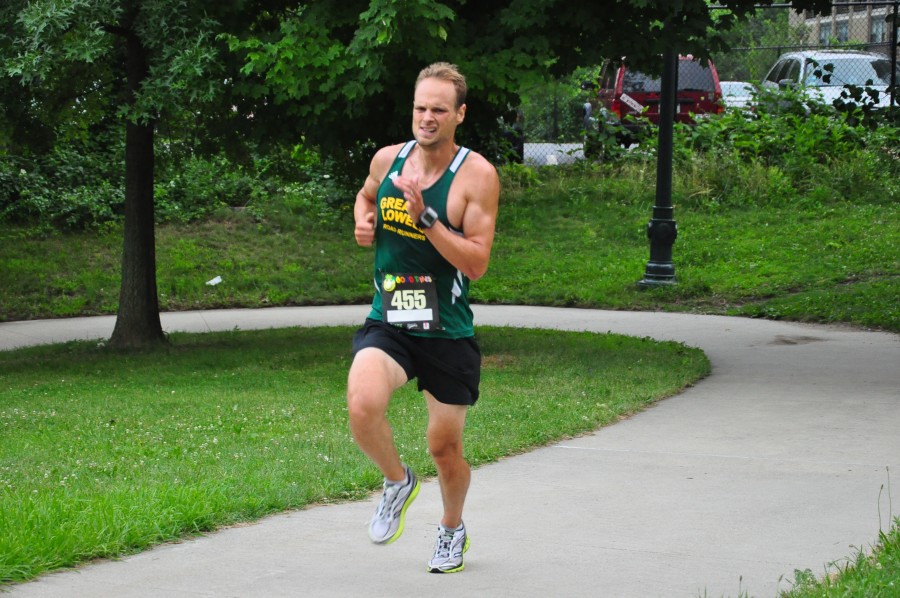
(Bash ran 4:31 pace for the last .1 of this race to get the oveted sub 17 he worked so hard for-Photo courtesy of Ted Tyler)
Another workout I like is 7 miles run at goal half marathon pace, with a 3 mile warm up and a 3 mile cooldown. This is a fairly hard workout, and has to be built up to. Start with 4 miles at half pace and slowly add on throughout your training cycle. Every couple weeks add on to the distance run at half pace. Being able to run 7 miles at your half marathon pace with no Adrenalin, no crowd support, and no one to chase will make the first half of your race feel like a breeze. Again, you shouldn't be racing the 7 miles of the workout. Your 7 mile race time should actually be much faster, so you should feel in control.
For your folks running Lone Gull 10K or Falmouth, a good predictor workout is 2 x 6k (5 mins rest) at 10K pace. Kara Haas ran this workout leading up to the BAA 10K at 5:55 pace. The result? She ran 37:47 (in brutal conditions I might add), won her division and was 10th overall for females in a very competitive race.

(Coverglrr Kara Haas)
The key to predictor workouts is finding how much is enough that the workout will be hard enough that it will properly indicate your fitness, but it will have enough recovery built in to allow you to fully recover for your race. Race day magic takes care of the rest (Adrenalin, crowd support, people to chase, and proper rest) .


